From Newtonian to Quantum: Why brand authority in the AI era is not your traditional SEO — EverythingMachines
In my last post I shared my experience using Perplexity to research a purchase. Every time we use an Everything Machine (e.g. Perplexity, ChatGPT, Gemini, etc) to research products, it comes at the expense of a “traditional” Google search. Gartner predicts search engine traffic could drop by as much as 50% by 2028. There is evidence that we’ve hit peak SEO and the Everything Machines are on the rise.
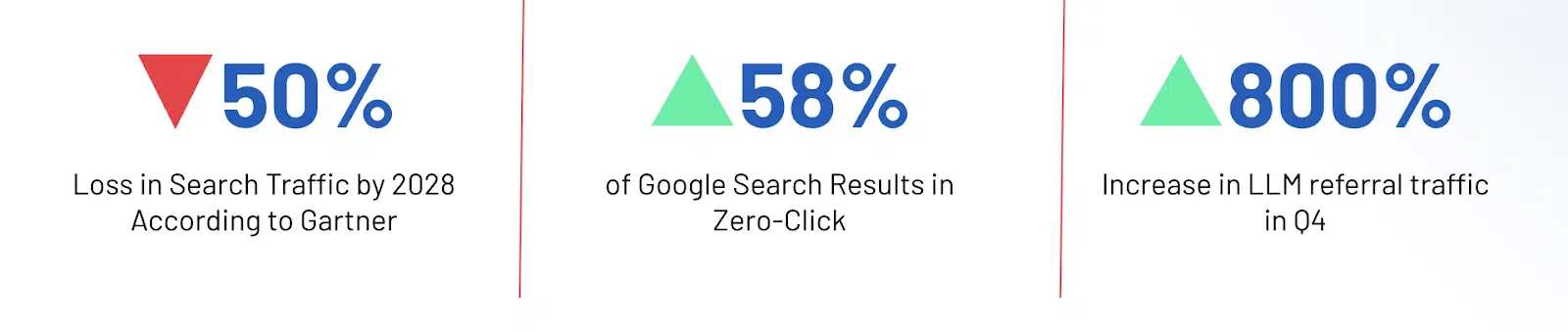
When I was running Influencer Marketing Hub, I saw this change first hand. Our traffic was fluctuating wildly due to Google’s increasingly frequent core updates and the introduction of AI Overviews. At the same time, we started to notice incoming traffic from ChatGPT and Perplexity. While SEO traffic is declining and Everything Machines traffic is increasing, the two can’t be directly compared. The nature of the technologies, user experience and traffic make them fundamentally different.
Traditional SEO: The Newtonian Physics of Go-To-Market
Traditional SEO operates much like Newtonian physics—a deterministic system with clear cause-and-effect relationships:
Predictable Outcomes: Specific keyword strategies and backlink profiles predictably affect brand rankings in search results
Measurable Metrics: Rankings, CTR, conversions, and lead generation are precisely measurable, trackable, and relatively consistent
Rule-Based Environment: Google's algorithms, while complex, follow discernible patterns that brands can observe, document, and leverage
Linear Improvements: Incremental changes (optimizing product pages, building industry backlinks) typically yield proportional results in traffic and conversions
Brands succeed by optimizing around these "laws" of search engines. They conduct competitive keyword research, optimize product pages, build quality backlinks, and refine conversion funnels—all with relatively predictable outcomes for customer acquisition.
Everything Machine AI Optimization: Brand Authority in the Quantum Realm
Establishing brand authority for the Everything Machines and their large language models enters a realm similar to quantum physics - probability replaces certainty, and multiple states exist simultaneously:
Probabilistic Authority: Like quantum particles that exist in multiple states until observed, a brand's representation in AI outputs varies based on the totality of its digital footprint and contextual factors. Multiple LLM prompts on the same topic result in differing results.
Emergent Brand Presence: Minor changes in how information about your brand is structured online can trigger completely different AI representation patterns
Contextual Variability: The Everything Machines produce different outcomes with seemingly identical inputs. Your brand’s information can be interpreted differently based on who's asking about your brand, what they are asking and how they phrase their question, much like quantum superposition where particles exist in multiple states simultaneously.
Share of Mind vs. Share of Search: Success comes from understanding how to become the probabilistic "best answer" rather than the top-ranked link
In this quantum-like environment, brands are competing for share of voice and authoritative representation rather than simply ranking position or click-through rates.
Why This Distinction Matters
This fundamental difference demands a shift in how brands approach digital visibility:
SEO Thinking: "If we target keywords X with content Y and build Z backlinks, we should rank on page 1 and drive conversions."
AI Optimization Thinking: "If we establish ourselves as the authoritative source on topics related to our products and services across multiple dimensions, we increase the probability of being cited and recommended when users engage with AI systems."
Where traditional digital marketers might focus on conversion optimization and keyword targeting, effective AI brand relevance requires:
Authority Building: Becoming the definitive source on topics related to your products and services
Comprehensive Information Architecture: Structuring information about your brand, products, and expertise in ways AI systems can confidently understand
Multi-dimensional Presence: Publishing diverse, high-quality content and data that reinforces your expertise from multiple angles and sources
Training Beyond Guidelines: Inserting informative brand data in unexpected and appropriate places to support imitation learning
Consistency Across Ecosystems: Maintaining consistent brand messaging and expertise across the entire digital landscape
Bridging Both Worlds
Tomorrow’s successful brand will increasingly require mastery of both approaches. The deterministic world of SEO still governs direct customer acquisition, while the probabilistic nature of AI systems determines how your brand is represented when customers ask questions about your industry, products, or solutions.
As we navigate this transition, brands that can operate in both "Newtonian" and "Quantum" terms will have the lasting advantage—understanding when to optimize for direct traffic and conversions, and when to build multi-dimensional authority that makes you the probabilistic "best answer" when users engage with Everything Machines.
Does this comparison resonate with what you are seeing? Leave a comment and let me know. If you are a Brand and want to discuss how to adapt your go-to-market approach for AI-mediated authority, I’d love to connect.